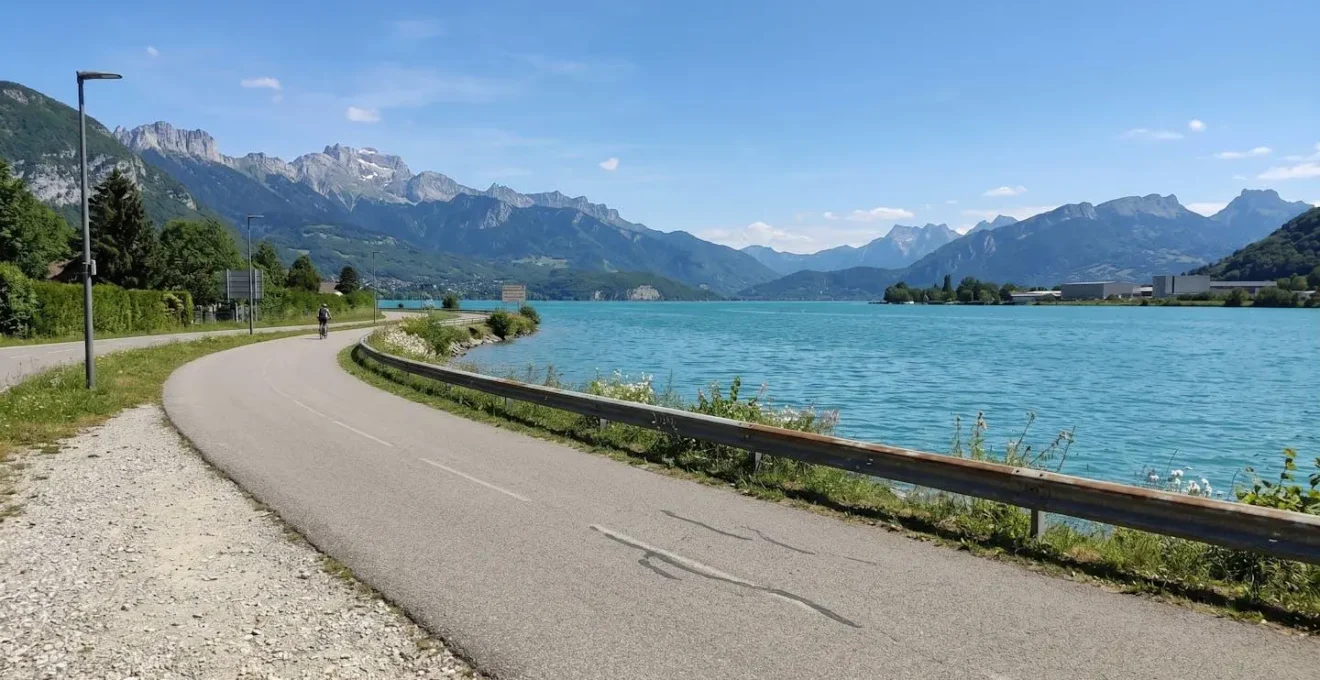
Ask ten cyclists how long the Lake Annecy loop takes, and you’ll receive ten different answers — ranging from a brisk two-hour sprint to a leisurely four-hour meander. Your actual riding time depends far less on fitness labels like “beginner” or “advanced” than on four concrete variables: the route segments you choose, your sustained cruising speed, the hour you depart, and how you plan your stops. Understand these factors, and you’ll swap vague time estimates for a realistic schedule that matches your rhythm.
The Lake Annecy cycling route attracts over 1.5 million passages annually on its busiest sections, according to SILA data (Syndicat Mixte du Lac d’Annecy). Peak season sees up to 10,000 daily crossings, meaning you’ll share the path with everyone from competitive road cyclists to families towing child trailers. This diversity explains why published time estimates swing so wildly — they’re trying to average fundamentally different riding experiences.
Four concrete variables determine your actual loop time with far more precision than vague fitness labels: the specific route segments you select from the full circuit or strategic half-loops, your realistic sustained pace measured in kilometres per hour rather than subjective ability categories, the departure timing that shapes wind resistance and pathway congestion throughout your ride, and how you structure stops for photos, meals, and brief rest breaks. Each factor compounds the others, explaining why identical riders can experience wildly different total trip durations.
Your 30-second Lake Annecy timing guide:
- The dedicated greenway spans 33 kilometres — expect 2 to 4 hours total trip time depending on choices
- Your sustained pace varies between 12 and 22 km/h based on fitness and bike type
- Morning departures beat afternoon headwinds that add 15-25 minutes on exposed sections
- Strategic photo stops and meal breaks can easily add 1 to 1.5 hours to pure riding time
Distance and route: Full loop versus strategic segments
The official Voie Verte offers 33 kilometres of purpose-built cycling infrastructure stretching from Annecy to Val de Chaise near Marlens, maintained as a 3.5-metre-wide paved path suitable for all abilities. The complete lake circuit — stitching together this greenway with secondary roads and shared pathways — effectively creates a continuous loop, though the eastern shore between Talloires and Doussard introduces roughly 100 metres of elevation gain, as the Office de Tourisme du Lac d’Annecy specifies, marking the route’s only significant climb.
Most riders select strategic segments matching their available time rather than completing the full circuit. The northern arc from Annecy through Sevrier to Talloires spans approximately 14 kilometres one-way with iconic lakeside views, while the southern route via Sevrier and Doussard extends closer to 17 kilometres through quieter shoreline sections.
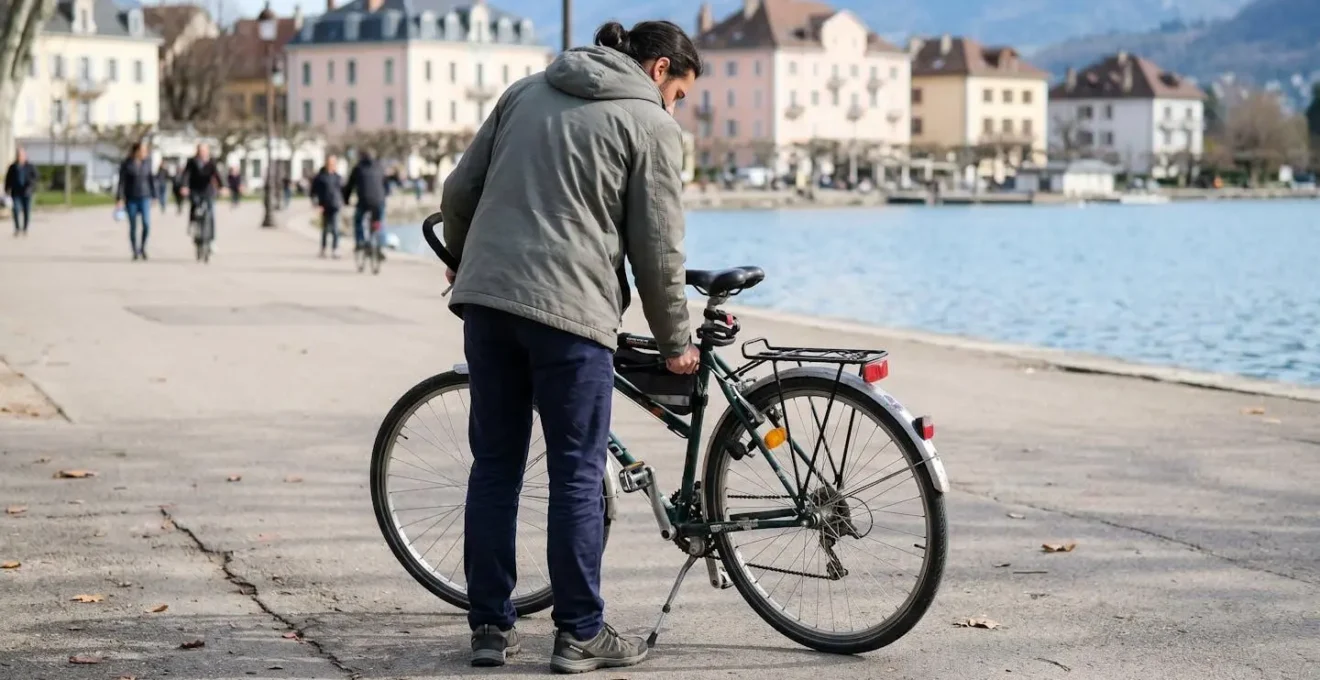
Your bike type dramatically reshapes these numbers. Rental comfort bikes — the chunky, upright city models with wide saddles and baskets — roll beautifully on flat tarmac but shed 2 to 3 km/h compared to lightweight sport hybrids. If you’re collecting recommendations for reliable equipment suited to the greenway’s smooth surface, mobilboard.com maintains a fleet specifically calibrated for Lake Annecy’s mixed terrain, offering both leisurely cruisers and performance-oriented options depending on whether you prioritize comfort or speed.
The table below translates route choices and rider profiles into realistic time windows. It distinguishes pure riding time from total outing duration once you account for inevitable pauses.
| Rider profile | Full loop (33km) | North segment (14km one-way) | South segment (17km one-way) |
|---|---|---|---|
| Leisure tourist (12-15 km/h) | 3h30-4h30 | 1h30-1h45 | 1h45-2h15 |
| Regular rider (15-18 km/h) | 2h45-3h15 | 1h15-1h30 | 1h30-1h45 |
| Sport cyclist (18-22 km/h) | 2h-2h30 | 1h-1h15 | 1h15-1h30 |
| Family group (10-12 km/h) | 4h-5h | 1h45-2h15 | 2h15-2h45 |
Your cycling pace: Beyond fitness labels
The cycling industry loves categorizing riders as “beginner,” “intermediate,” or “advanced,” but these labels obscure the metric that genuinely matters: your comfortable sustained speed over 90-plus minutes. A marathon runner might qualify as “advanced” in cardiovascular fitness yet struggle to maintain 16 km/h on an unfamiliar bike, while a casual weekend cyclist who rides frequently might cruise effortlessly at 18 km/h simply through muscle memory and efficient pedalling technique.
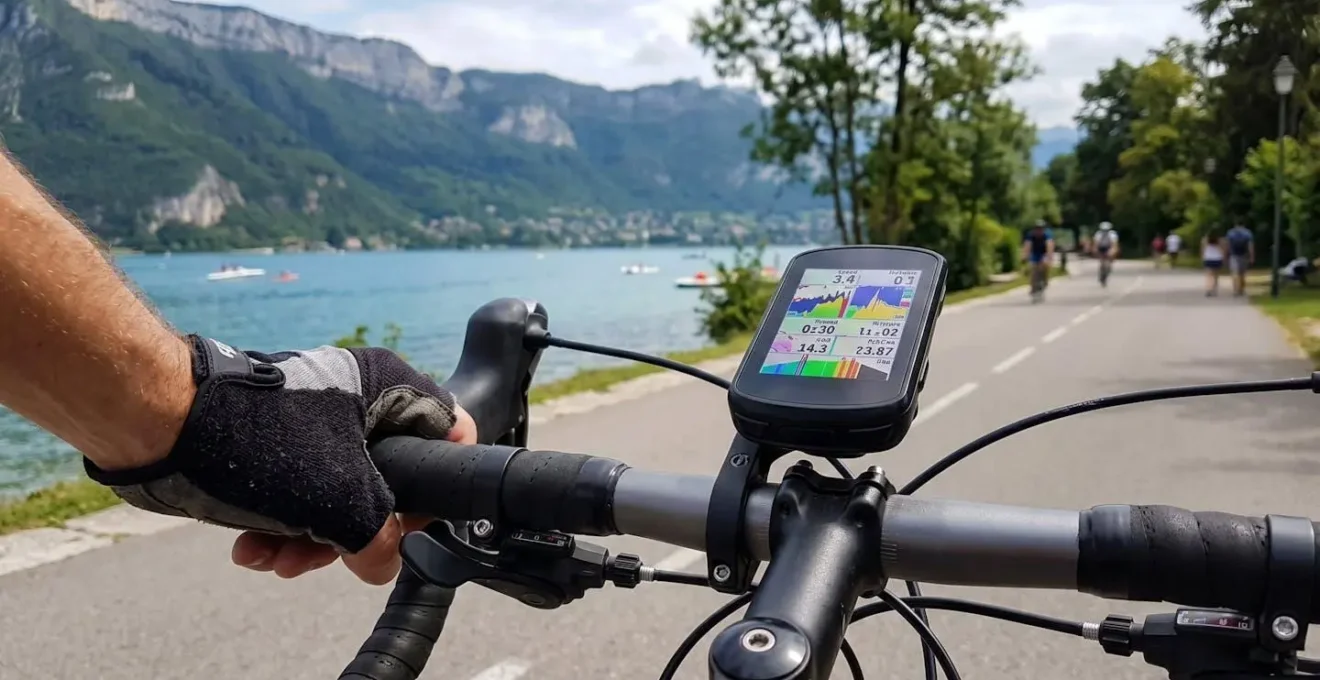
The decision tree below helps you pinpoint your realistic Lake Annecy pace by asking three practical questions instead of relying on vague self-assessment.
- How often do you currently cycle?
Once monthly or less: Expect 10-13 km/h (leisurely exploration pace).
Weekly recreational rides: Plan for 13-16 km/h (comfortable touring speed).
Multiple times weekly: You’ll likely sustain 16-19 km/h (efficient cruising).
Daily or training-focused: Budget for 19-22 km/h (sport performance). - What’s your typical comfortable cycling speed on flat routes?
Under 12 km/h: You’re prioritizing scenery absorption over efficiency — expect 2h30-3h+ for the full circuit.
12-15 km/h: Classic leisure touring pace; budget 2h30-3h riding time.
15-18 km/h: Brisk recreational speed; plan for 1h50-2h15 on the bike.
18+ km/h: Performance-oriented cruising; expect 1h30-1h50 saddle time.
National cycling tourism data reveals steady growth in pathway usage — 2024 figures from Réseau vélo et marche show a 2% increase in cycling frequency across France compared to 2023. This rising popularity means you’re more likely to encounter varied pace groups sharing the Annecy greenway, reinforcing why choosing your departure time matters as much as assessing your own speed.
Weather timing: Wind and season make the difference
Lake Annecy sits in a natural basin ringed by Alpine peaks, creating predictable wind patterns that experienced local riders exploit ruthlessly. Thermal currents build throughout the morning as the sun heats the lake surface, generating afternoon breezes that funnel down the valley and hit the exposed eastern shoreline — precisely the Talloires-to-Doussard stretch where the route climbs away from the water’s edge.
One frequently underestimated factor reshapes eastern shore timing predictably.
Afternoon wind trap on the eastern shore: Prevailing thermal winds typically strike the Talloires-Doussard section head-on during afternoon hours, adding approximately 15 to 25 minutes to this 12-kilometre stretch in most conditions compared to calm morning rides. Departures before 11am consistently avoid the worst resistance, while post-2pm starts face the stiffest headwinds. If afternoon riding proves unavoidable, budget extra time specifically for the eastern climb rather than spreading the penalty across your entire route estimate.
Seasonal timing reshapes the experience beyond pure meteorology. Summer weekends between June and September bring those 10,000-passage days when the waterfront sections slow with pedestrian crossings and crowded pathways. Spring (April-May) and autumn (September-October) deliver milder temperatures, thinner crowds, and calmer wind conditions — often cutting 10 to 15 percent from your riding time through unobstructed flow.
Strategic stops: The hidden time multiplier
Consider a common scenario: you’ve calculated 2 hours riding time at 16 km/h, departed at 10am expecting noon return, yet find yourself still pedalling at 1pm. The culprit: unplanned stops that accumulate relentlessly despite seeming innocuous individually.
Typical unplanned stops accumulate quickly:
- Quick photo at Sevrier beach viewpoint: 6 minutes
- Coffee halt in Talloires: 18 minutes
- Restroom stop in Doussard: 8 minutes
- Spontaneous gelato pause in Annecy-le-Vieux: 12 minutes
Total unplanned additions: 44 minutes — nearly doubling your margin of error.
The checklist below transforms vague time estimates into structured calculations that account for reality rather than wishful thinking.
- Determine your realistic sustained pace using the decision tree in section 2
- Calculate pure riding time: divide your chosen distance (33km full loop, 14km north, 17km south) by your km/h pace
- Add planned photo stops: allocate 5-10 minutes each, expect 3-4 stops minimum on the full circuit
- Add meal or extended coffee break if desired: 15-20 minutes for quick refreshment, 45-60 minutes for sit-down lunch
- Include a 15-20 minute buffer for unexpected pauses (mechanical adjustments, navigation checks, brief rest)
- Sum all components for your realistic total trip time — this is the number to communicate to companions or use for booking return transport
Experienced riders distinguish sharply between “saddle time” and “outing duration.” The former measures actual pedalling hours; the latter encompasses the complete experience including transitions, exploration, and recovery. Treating them as identical guarantees either rushed riding (sacrificing the enjoyment that justified the trip) or missed commitments (generating stress that undermines the supposed relaxation).
The questions below address residual planning uncertainties riders commonly face.
Can I cycle the Lake Annecy greenway in under 2 hours?
Only sport-level cyclists maintaining 20+ km/h continuously without stops achieve sub-2-hour completion times for the 33-kilometre route. Most riders require 2 to 4 hours depending on pace, route choice, and break frequency. The competitive minority racing through miss the scenic payoff that justifies visiting Annecy in the first place.
What departure time minimizes wind resistance?
Morning starts between 8am and 11am typically avoid the thermal headwinds that build on the eastern shore after midday. Afternoon departures face predictable resistance on the Talloires-Doussard section, adding 15-25 minutes to that segment. Early riding also dodges peak tourist congestion along the Annecy-le-Vieux waterfront.
Do I need high fitness levels to complete the loop?
Peak cardiovascular fitness isn’t required, but you should comfortably sustain 2 to 4 hours of gentle pedalling depending on your chosen pace. The route’s accessibility lies in time flexibility rather than technical difficulty — slower riders simply allocate more hours rather than confronting impossible terrain. Families with young children regularly complete segments by accepting leisurely 10-12 km/h speeds and frequent breaks.
What to prioritize before you depart
The Lake Annecy greenway rewards preparation over optimism. Calculate your total outing time by honestly assessing your sustained pace, factoring in planned stops, and adding a buffer for the inevitable unplanned pauses that make cycling tourism enjoyable rather than a timed trial. Morning departures dodge both wind resistance and pathway congestion, while selecting strategic segments instead of forcing the full loop often delivers superior experiences for riders with limited time or moderate fitness.
Three principles anchor effective Lake Annecy time planning.
Essential timing principles
- Sustained cruising speed matters more than fitness labels for realistic time estimates
- Morning departures avoid eastern shore wind penalties and pathway congestion consistently
- Distinguish saddle time from total duration by accounting for all stops