
A single undetected electrostatic discharge can destroy a £200 integrated circuit in microseconds, yet the operator responsible may never feel, see or hear the event. For quality managers overseeing electronics manufacturing, this invisible threat represents a persistent challenge: how to justify significant investment in prevention when the damage itself remains largely hidden until components fail weeks or months later in the field.
Unlike visible workplace hazards, electrostatic discharge (ESD) operates silently. An operator walking across synthetic flooring can generate 15,000 volts without awareness, whilst modern CMOS components fail at exposures below 100 volts. The gap between everyday static generation and component vulnerability creates a protection challenge that transcends simply purchasing antistatic equipment. An effective ESD control programme requires coordinated equipment selection, normative compliance, operator training and maintenance protocols tailored to your specific operational environment.
Effective quality management in electronics manufacturing requires a deep understanding of the tools used to neutralize static threats. To achieve a defensible level of protection, facility managers must rely on certified ESD personal equipment that facilitates a safe and continuous earthing path for every operator. Selecting professional-grade hardware is the most reliable method to bridge the gap between theoretical safety standards and real-world production demands.
Recent client audits increasingly scrutinise ESD programmes beyond basic compliance, examining whether protection measures genuinely reflect the sensitivity of components handled, the realities of production workflows, and the documented evidence of ongoing effectiveness. For facilities working toward ISO certification or responding to audit findings, a systematic approach grounded in BSI ESD control programme standards provides defensible, verifiable protection.
- What makes static electricity a workplace hazard?
- The fundamentals of ESD protection systems
- Which personal grounding equipment does your team need?
- Compliance standards every facility should meet
- How to select reliable ESD equipment for long-term use?
- Implementing an effective ESD protection programme
- Moving from compliance to competitive advantage
What makes static electricity a workplace hazard?
The economic impact of ESD extends far beyond the immediate replacement cost of a destroyed component. Peer-reviewed research citing historical industry estimates reports that the global electronics sector lost over $8 billion annually to ESD damage, with an effective control programme potentially worth up to $500 million yearly to a large manufacturer. Whilst these figures derive from 2001 data, they establish the order of magnitude: even a modest reduction in ESD-related defects delivers measurable financial return.
The challenge lies in recognising the full scope of damage. Catastrophic failures—components that fail immediately during functional testing—represent only the visible portion of ESD impact. Far more insidious are latent defects: partial damage that degrades component performance without causing immediate failure. A circuit that passes all production tests may fail after six months of field operation, generating warranty costs, customer dissatisfaction and potential contract non-renewal. Because latent damage often goes unattributed to ESD, organisations systematically underestimate the true cost of inadequate protection.
$500 million
Estimated annual value of an effective ESD control programme for a large electronics manufacturer, based on industry research into prevented losses from both catastrophic and latent component damage.
Beyond direct component costs, ESD incidents trigger cascading operational expenses: production line downtime during fault investigation, scrap material, rework labour, delayed shipments, and the administrative burden of root-cause analysis. For facilities supplying aerospace, medical or automotive sectors, ESD-related non-conformances carry additional contractual penalties and certification risks.
The physics of the threat intensifies the challenge. Walking across a typical carpet in low humidity can generate 35,000 volts. Removing a synthetic garment produces 15,000 volts. Handling common plastic packaging materials creates 10,000 volts. Meanwhile, modern integrated circuits suffer damage at exposures between 50 and 200 volts depending on their technology. This enormous voltage disparity—ordinary activities generating charges hundreds of times greater than damage thresholds—means uncontrolled environments create ESD events constantly, whether or not anyone perceives them.
In the UK and EU, whilst ESD protection for component integrity falls primarily under quality management rather than statutory health and safety, HSE guidance confirms that earth bonding combined with antistatic work clothing and footwear reduces static discharge risk in explosive atmospheres under DSEAR regulations. For electronics manufacturing, client contracts and sector certifications (particularly in aerospace, medical devices and automotive electronics) increasingly mandate documented ESD control programmes compliant with international standards.
The financial case for investment becomes clear when framed against the cost of non-compliance: a single batch of defective assemblies reaching a major customer can exceed the total cost of a comprehensive ESD programme, whilst simultaneously jeopardising contract renewal and company reputation.
The fundamentals of ESD protection systems
All effective ESD protection strategies share a common foundation: earthing (the British English term, distinct from the American “grounding”). The principle is straightforward—eliminate the electrical potential difference between the operator, the component being handled, and the surrounding work environment. When all elements exist at the same electrical potential, charge cannot flow between them, and damaging discharge cannot occur.
Understanding material behaviour underpins intelligent equipment selection. ESD control programmes classify materials into three categories based on their surface resistance, measured in ohms:
Surface resistance classifications per IEC 61340-5-1: Conductive materials (< 1 × 10⁴ Ω) dissipate charges extremely rapidly but risk fast discharge that can itself damage sensitive components. Dissipative materials (≥ 1 × 10⁴ to < 1 × 10¹¹ Ω) provide controlled, safe charge dissipation—the preferred range for most ESD applications. Insulative materials (≥ 1 × 10¹¹ Ω) prevent charge movement entirely, allowing dangerous static accumulation and are generally prohibited in ESD protected areas except when neutralised through ionisation.
This classification system directly informs equipment specifications. When evaluating suppliers’ technical datasheets for ESD matting, footwear, wrist straps or garments, the stated surface resistance must fall within the dissipative range to provide effective, safe protection. Values outside this range indicate either inadequate protection or potential risk to components.
The concept of common point ground explains why isolated protective measures fail. If an operator wears an earthed wrist strap but places components on a non-ESD work surface, the surface itself becomes a potential discharge source. Similarly, earthing the work surface whilst allowing the operator to accumulate charge through insulative footwear leaves the operator as the threat. Effective protection requires the operator’s body, the work surface, any tools or fixtures, and the components themselves all to be connected to the same verified earth reference point.
For materials that cannot be earthed—such as many plastic component carriers, packaging films, or non-conductive equipment housings—ionisation provides an alternative control method. Ionisers generate balanced streams of positive and negative ions that neutralise static charges on insulative surfaces. Whilst ionisation addresses specific challenges, it cannot replace fundamental earthing and should be viewed as a complementary technology for unavoidable non-conductive materials within an otherwise earthed environment.
A further technical consideration in material selection is dissipation time: the speed at which accumulated charge drains away through a dissipative material to earth. Whilst surface resistance indicates a material’s ability to dissipate charge, dissipation time measures how quickly this occurs in practice. For high-speed production environments handling extremely sensitive components, faster dissipation times within the acceptable dissipative range may justify premium material selection.
Which personal grounding equipment does your team need?
Personal grounding equipment selection demands careful matching between the specific protection requirements of your operation, the working patterns of your operators, and the realistic constraints of comfort and productivity. A systematic approach by workstation type and operator mobility yields more effective outcomes than attempting to apply a single solution across diverse environments.
Wrist straps for stationary workstations
Wrist straps remain the foundational personal earthing device for operators at fixed workstations. A properly functioning wrist strap maintains continuous electrical connection between the operator’s skin and the earthed work surface via a coiled cord containing a built-in current-limiting resistor (typically 1 megohm). This resistor provides crucial operator protection: in the event the operator contacts mains voltage, the resistor limits current flow to safe levels whilst still allowing effective static charge dissipation.
Effective wrist strap programmes require more than initial purchase. The adjustment strap contacting the operator’s wrist must provide consistent skin contact throughout the working day—bands that are too loose fail to provide reliable earthing, whilst excessively tight bands cause discomfort that reduces operator compliance. The coiled cord connection point represents a common failure mode; repeated flexing degrades the internal conductor, eventually creating an open circuit. Without regular testing, failed wrist straps provide false confidence whilst offering zero protection.
The fundamental limitation of wrist straps is their requirement for a stationary, earthed workstation. Operators who move between work areas, walk to collect components, or work at multiple stations lose protection the moment they disconnect. For mobile operators, footwear-based earthing becomes necessary.
ESD footwear versus heel grounders
The choice between specialized protective gear, such as full ESD footwear and heel grounders, hinges primarily on operator mobility requirements and the specific type of ESD flooring installed throughout the facility
Heel grounders—conductive straps worn around the shoe heel that contact the floor—offer a cost-effective solution for operators at fixed workstations with ESD floor mats. They function adequately when the operator remains standing on the earthed mat but provide no protection when the operator steps away. Comfort complaints are common: the straps require secure fastening to maintain floor contact, which can feel restrictive during extended shifts.
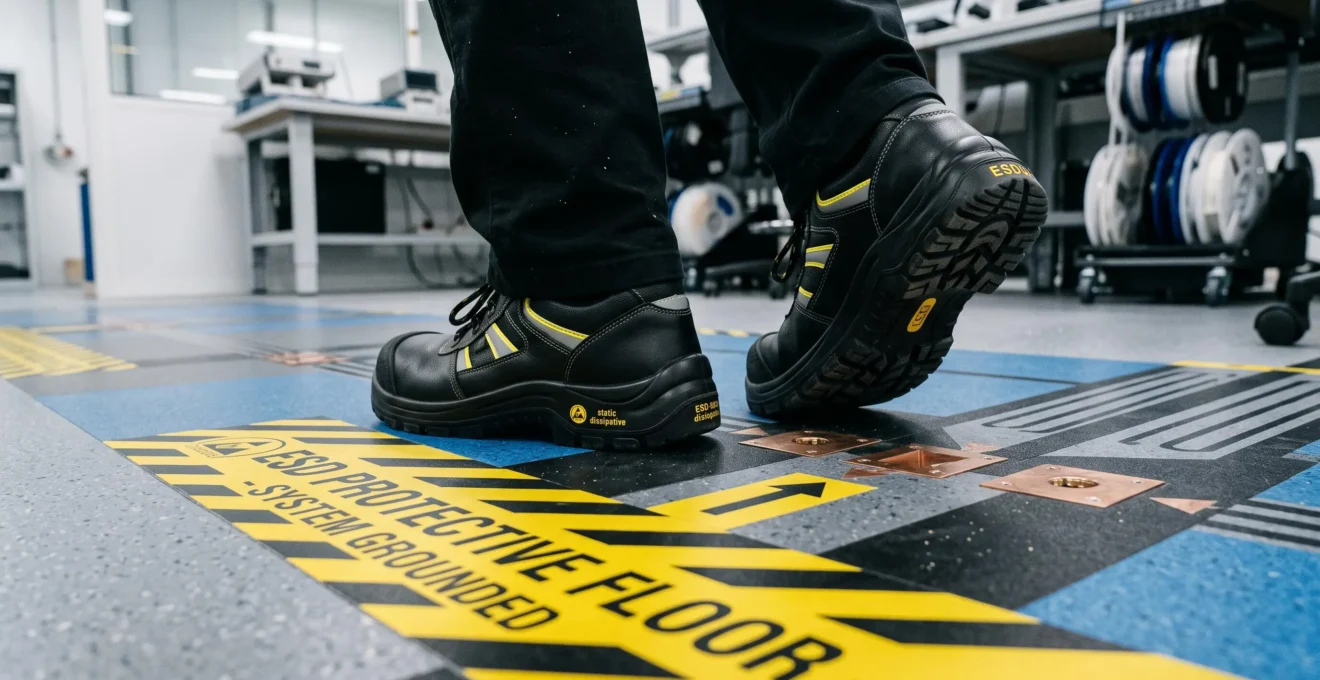
ESD footwear—purpose-manufactured shoes with dissipative soles—provides continuous protection as operators move throughout an ESD-protected area with conductive or dissipative flooring. The higher initial cost per pair is offset by several advantages: greater operator acceptance due to comfort, no daily fitting or adjustment, and maintained protection during movement. For facilities with multiple workstations or operators who collect materials from stores, ESD footwear delivers more reliable protection.
| Criterion | Heel grounders | ESD footwear |
|---|---|---|
| Initial cost per operator | £8–15 per pair | £40–90 per pair |
| Suitable for mobile operators | No—protection only on mat | Yes—continuous protection on ESD flooring |
| Operator comfort | Frequent adjustment needed; strap discomfort | Worn like normal footwear; high acceptance |
| Daily fitting requirement | Yes—requires correct placement each shift | No—simply worn as regular shoes |
| Typical operational lifespan | 3–6 months depending on usage intensity | 12–18 months with proper care |
ESD garments and gloves
Standard synthetic clothing generates substantial static charge through friction during normal movement—the familiar crackle when removing a polyester jumper demonstrates charge levels far exceeding component damage thresholds. ESD garments—laboratory coats, smocks or coveralls manufactured from dissipative fabrics—prevent charge generation by the operator’s clothing and are essential in cleanroom environments where particulate control and ESD protection must coexist.
ESD garment selection involves trade-offs between protection level, laundry durability, and cost. Woven fabrics incorporating conductive fibres (typically carbon or stainless steel) throughout the garment provide reliable, long-lasting protection through hundreds of laundry cycles but command higher initial prices. Topical treatments applied to standard fabrics offer lower upfront costs but degrade with each wash, eventually requiring garment replacement when surface resistance rises beyond acceptable limits.
ESD gloves present a particular challenge: they must provide electrostatic protection whilst preserving the finger dexterity required for precise component handling. Excessively thick gloves reduce productivity and increase assembly errors, generating resistance from production teams. The optimal solution—thin, form-fitting gloves manufactured from dissipative materials—costs more than basic options but prevents the productivity degradation that undermines programme acceptance. For operations handling very small surface-mount components, fingerless ESD gloves that protect the hand whilst leaving fingertips exposed may offer an acceptable compromise, though this requires careful assessment of the actual ESD risk posed by exposed fingertips in your specific assembly process.
Compliance standards every facility should meet
Multiple international and national standards govern ESD protection programmes, each with specific scope and requirements. Understanding which standards apply to your facility—and what they actually require beyond simply purchasing certified equipment—proves essential for defensible compliance and successful client audits.
IEC 61340-5-1 represents the primary international standard for ESD control programmes. Developed by the International Electrotechnical Commission, this standard establishes both administrative and technical requirements for organisations handling electrostatic-sensitive devices. The standard applies to activities handling components with withstand voltages at or above 100 volts Human Body Model (HBM), 200 volts Charged Device Model (CDM), or 35 volts for isolated conductors. Components with lower withstand voltages may require additional control measures or more stringent limits than the standard specifies.
For UK facilities, BS EN IEC 61340-5-1:2024 represents the British Standards Institution’s adoption of the international IEC standard, with identical technical requirements. When preparing for certification or client audits within the UK or EU, referencing the BS EN standard demonstrates awareness of the nationally recognised version, though the content remains equivalent to the IEC original. Compliance with BS EN IEC 61340-5-1 satisfies most UK and European client requirements for component-level ESD protection.
ANSI/ESD S20.20, developed by the ESD Association in the United States, provides an alternative ESD programme standard widely recognised in North America. UK facilities supplying to American clients or operating as part of US-headquartered multinationals frequently face contractual requirements to demonstrate ANSI/ESD S20.20 compliance regardless of their geographic location. The core principles of the ANSI and IEC standards align closely—both require earthing, controlled materials, personnel grounding, and documented programmes—though specific test methods and acceptance criteria show minor differences.
Multiple standards compliance: Electronics manufacturers supplying international clients may need to demonstrate compliance with both BS EN IEC 61340-5-1 and ANSI/ESD S20.20 simultaneously. Whilst the standards share common principles, documented evidence of compliance with both requires attention to the specific test methods and acceptance criteria each standard mandates. Plan your compliance programme to address the most stringent requirements if multiple standards apply to your customer base.
Beyond specifying equipment performance, these standards define operational requirements that distinguish genuine programmes from mere equipment purchases:
- ESD Control Programme Plan: a documented plan identifying ESD-sensitive items handled, protection measures implemented, and responsibilities assigned;
- Compliance verification: regular auditing of the programme to verify ongoing effectiveness and conformance to the plan;
- Training records: documented initial and periodic refresher training for all personnel handling ESD-sensitive items;
- Periodic testing: scheduled verification testing of all ESD control items (wrist straps, footwear, work surfaces, ionisers) with documented results and corrective actions.
The documentation requirement proves particularly important during client audits and ISO certification assessments. Possession of compliant equipment provides insufficient evidence without accompanying records demonstrating regular testing, operator training, and programme review. Facilities responding to recent audit findings typically discover the gap lies not in equipment capability but in documented evidence of systematic programme management.
How to select reliable ESD equipment for long-term use?
The UK market offers an extensive range of ESD control products spanning wide price brackets, with marketing claims that often obscure genuine performance differences. Distinguishing truly effective, durable equipment from substandard alternatives requires evaluating objective, verifiable criteria rather than accepting supplier assurances at face value.
Measurable technical specifications
Effective equipment selection begins with technical specifications that can be independently verified. Surface resistance measurements, clearly stated and falling within the dissipative range defined by IEC 61340-5-1 (1 × 10⁴ to 1 × 10¹¹ ohms), provide the fundamental performance criterion. Suppliers should provide test data demonstrating that their products meet these values when new and, crucially, maintain them throughout the product’s operational life.
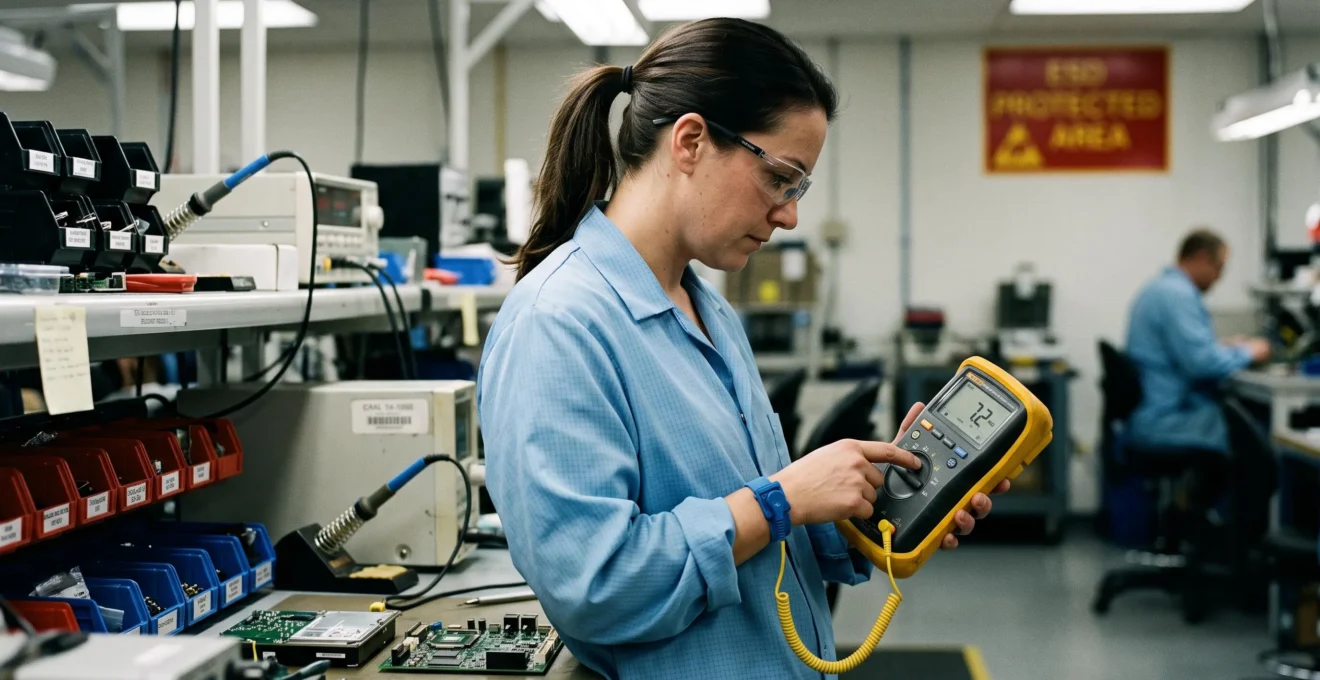
For wrist straps, verify that the complete system—band, cord and connection—exhibits total resistance between 800 kilohms and 10 megohms per ANSI/ESD S20.20 requirements. For footwear, the resistance between the operator wearing the shoes and the floor should fall within the specified range when measured using the standard foot-to-floor test method. Garments should maintain surface resistance within acceptable limits through a defined number of laundry cycles—reputable suppliers provide wash-test data demonstrating performance degradation curves.
Independent certification provides additional confidence. Equipment tested and certified by recognised third-party laboratories (rather than solely by the manufacturer) offers greater credibility. Certification marks from organisations such as the ESD Association indicate that equipment has undergone standardised testing protocols, though certification alone does not guarantee suitability for your specific application—you must still verify the certified parameters match your requirements.
Total cost of ownership versus initial price
Budget constraints naturally drive purchasing teams toward lowest-price options, yet this approach often increases long-term costs. A £15 pair of ESD shoes that requires replacement every four months costs more over two years than £70 shoes lasting eighteen months, whilst also creating additional administrative burden for procurement and increased risk of protection gaps during replacement.
For launderable garments, the key metric is performance retention through wash cycles. A smock maintaining compliant surface resistance through 100 industrial laundry cycles delivers far better value than a cheaper alternative failing at 30 washes, even if the initial price appears attractive. Suppliers should provide documented wash-durability data—absence of such data suggests unproven or poor durability performance.
Mechanical durability equally affects total cost. Wrist strap cords subjected to repeated stretching and coiling fail through conductor fracture; robust strain relief at connection points and higher-quality coiled-cord construction significantly extend operational life. Work surface mats enduring chemical exposure, mechanical abrasion from tooling, and frequent cleaning require materials that resist degradation—cheaper mats may save money initially but require replacement within months rather than years.
Operator comfort and programme compliance
Technically perfect equipment that operators find uncomfortable or cumbersome will not be worn correctly—or potentially not worn at all. Non-compliance due to discomfort undermines the entire protection programme. This makes comfort a technical requirement, not merely a preference.
For gloves, the balance between protection and dexterity proves critical. Excessively thick gloves slow assembly work and increase error rates, creating production pressure to remove them. Investment in premium thin-gauge ESD gloves that preserve finger sensitivity prevents the productivity loss that generates resistance from production teams and supervision.
Footwear comfort determines all-day compliance. ESD shoes that cause foot fatigue or discomfort by mid-shift will be removed during breaks or replaced with non-compliant personal footwear. Providing operators with a choice between several approved ESD footwear styles—different manufacturers offer varying fit characteristics—improves acceptance rates significantly.
Garment breathability affects compliance in temperature-controlled cleanrooms and production areas. Dissipative fabrics that trap heat cause discomfort during physical work; more breathable constructions (typically at higher cost) maintain operator comfort and therefore consistent wear throughout shifts.
Supplier evaluation criteria
Technical specifications and product quality represent only part of the selection equation. Supplier reliability directly impacts your operational continuity. Consider these factors:
- UK-based stock availability and lead times compatible with your production continuity requirements
- Technical support capability to advise on application-specific product selection and troubleshooting
- Documented quality management system demonstrating consistent product specifications
- Availability of compliance documentation (test reports, certifications, material safety data)
- Range of product options allowing scaling from pilot implementation to full facility deployment
- References from comparable UK electronics manufacturing facilities
Implementing an effective ESD protection programme
Purchasing compliant equipment represents the beginning of ESD protection, not its completion. The gap between equipment acquisition and effective protection narrows only through systematic implementation addressing training, testing, documentation and continuous improvement.
Operator training beyond rule-following
Effective ESD training extends beyond instructing operators to wear wrist straps and avoid certain materials. Operators who understand why ESD damages components, how their bodies generate charge, and the consequences of inadequate protection demonstrate significantly better compliance than those simply following rules without context.
Initial training should cover the physics of static generation in accessible terms, the vulnerability of the specific components your facility handles, the function of each piece of protective equipment, and the correct procedures for equipment use and testing. Crucially, training must address the invisibility of ESD—operators receive no sensory feedback when they cause damage, making consistent adherence to procedures psychologically challenging.
Periodic refresher training addresses the natural decline in compliance vigilance over time. Annual refresher sessions, ideally incorporating recent ESD incidents or audit findings from your facility, maintain awareness and reinforce correct practices. Documentation of all training—dates, attendees, topics covered—provides essential evidence during client audits and ISO assessments.
Systematic periodic testing
ESD equipment degrades through normal use. Wrist strap cords develop fractures, shoe soles accumulate insulating contamination, work surface mats degrade chemically, and garments lose conductivity through repeated laundering. Without regular testing, degraded equipment provides false security whilst offering no actual protection.
IEC 61340-5-1 and ANSI/ESD S20.20 specify minimum testing frequencies for different equipment categories. Wrist straps typically require daily verification at the start of each shift using simple continuity testers. Footwear testing frequencies vary by standard but commonly require monthly verification. Work surfaces, floor mats and other fixtures require testing at installation and periodically thereafter (often quarterly or semi-annually depending on use intensity).
Testing generates documentation requirements: logs recording test dates, results, equipment identifiers, and corrective actions taken for out-of-specification results. These records demonstrate programme effectiveness during audits and provide early warning of systematic equipment failures requiring supplier investigation or product change.
Phased deployment minimising production disruption
The operational constraint of maintaining production continuity during ESD programme implementation or upgrade requires careful deployment planning. A phased approach by work area or production line reduces risk and allows learning from initial implementation before full-facility rollout.
A typical phased deployment follows this pattern: select a pilot area representing typical operations and ESD risks; implement complete protection (equipment, training, testing protocols) in this zone; operate the pilot for sufficient time to identify issues, refine procedures and demonstrate effectiveness; extend to remaining areas sequentially whilst maintaining production schedules. This approach allows equipment evaluation under real working conditions before large-scale procurement, identifies training gaps early, and demonstrates ROI in the pilot area to support wider investment approval.
Documentation and traceability systems
Client audits and ISO certification assessments demand documented evidence of programme effectiveness. Essential documentation includes:
- The ESD Control Programme Plan identifying ESD-sensitive items, protection measures implemented, responsible personnel, and compliance verification schedule;
- Training records documenting who received training, when, on which topics, and with what assessment outcome;
- Equipment test logs recording periodic verification results for all ESD control items;
- Audit records from internal programme reviews and external client assessments, including corrective actions;
- Non-conformance reports documenting ESD events, investigations and preventive measures implemented.
Modern quality management systems can integrate ESD documentation with broader ISO 9001 quality records, providing centralised traceability and automated reminders for periodic testing and training renewal. Even simple spreadsheet-based tracking systems prove adequate if maintained consistently and made accessible during audits.
Building a culture of continuous improvement
Mature ESD programmes evolve beyond compliance checklists toward genuine continuous improvement. Encouraging operators to report near-misses and potential ESD risks without blame generates valuable insights for programme refinement. Analysing ESD incidents for root causes—equipment failure, procedural gaps, training inadequacy, or environmental factors—drives targeted improvements rather than generic responses.
Regular programme reviews examining test failure trends, audit findings, and process changes identify opportunities to enhance protection or improve efficiency. A programme that adapts to new component sensitivities, production methods, or equipment technologies maintains effectiveness as your operation evolves.
- Assess current state and requirementsConduct a thorough ESD risk assessment identifying all ESD-sensitive components handled, existing protection measures, compliance gaps, and specific requirements from client contracts or sector standards applicable to your facility.
- Define programme scope and standardsDetermine which ESD standards apply based on your customer requirements (BS EN IEC 61340-5-1, ANSI/ESD S20.20, or both), and document this in a formal ESD Control Programme Plan establishing responsibilities, protection measures and verification schedules.
- Select and procure appropriate equipmentSpecify equipment based on objective technical criteria (surface resistance, certification, durability data), balancing performance requirements against budget constraints and operator comfort to ensure sustained compliance.
- Implement in pilot area firstDeploy complete protection—equipment, training, testing protocols—in a representative pilot area, allowing refinement of procedures and demonstration of effectiveness before facility-wide rollout.
- Train all personnel thoroughlyProvide comprehensive initial training covering ESD physics, component vulnerability, equipment function and proper procedures, with documented attendance and competency verification for all operators handling ESD-sensitive items.
- Establish periodic testing routinesImplement scheduled testing for all ESD equipment per standard requirements (daily wrist strap verification, monthly footwear testing, periodic surface testing), with documented results and corrective action procedures for failures.
- Document systematicallyMaintain complete records of training, testing, audits and non-conformances, ensuring documentation accessibility for client audits and ISO certification whilst supporting programme improvement through trend analysis.
- Review and improve continuouslyConduct regular programme audits, analyse test failure trends and incident root causes, update procedures as production processes evolve, and maintain management visibility through periodic programme effectiveness reporting.
Do premium ESD equipment products genuinely provide better protection than basic alternatives, or is the price difference purely marketing?
The distinction between premium and basic ESD equipment centres on durability, comfort and total cost of ownership rather than fundamental protection capability when new. Both product tiers must meet the same surface resistance specifications to claim ESD protection. Premium products typically differentiate through longer operational life (more wash cycles for garments, more robust mechanical construction for wrist straps), superior operator comfort encouraging consistent compliance, and better-documented performance data from independent testing. The protection effectiveness on day one may be identical; the difference emerges in maintained performance over months of use and in operator acceptance rates. For budget-constrained programmes, selecting basic equipment for low-wear applications whilst investing in premium options for high-use items (such as daily-wear footwear or frequently laundered garments) optimises spending.
How can I demonstrate return on investment for ESD equipment to management when our facility hasn’t experienced major component failures recently?
Building an ROI case for preventive investment requires quantifying both direct costs avoided and risk mitigation value. Direct costs include: replacement value of typical sensitive components you handle multiplied by conservative failure rate estimates from industry data, rework labour costs for rejected assemblies, and production downtime during fault investigation. Risk mitigation value encompasses: cost of a single significant customer return or warranty claim (which often exceeds total programme cost), contractual penalties or lost business from client audit failures, and certification costs if ISO or sector-specific accreditation requires demonstrated ESD control. Frame the business case around cost of non-compliance rather than return from compliance—a single batch rejection or audit failure typically exceeds total programme investment. Additionally, pilot-area data showing reduced defect rates or successful client audits provides internal proof points strengthening the case for wider deployment.
Will implementing new ESD equipment and procedures disrupt our production schedule and reduce short-term output?
Thoughtfully planned deployment minimises production disruption through phased implementation and off-shift preparation. Install ESD flooring, matting and workstation earthing points during scheduled maintenance windows or second-shift hours. Conduct operator training in small groups during natural production lulls rather than shutting entire lines. Implement equipment changes by work area sequentially rather than facility-wide simultaneously, allowing production to continue in unchanged areas whilst new procedures bed in elsewhere. The transition period for operators adapting to new equipment (particularly footwear and gloves) typically spans one to two weeks; productivity returns to baseline once familiarity develops. Most facilities report that systematic phased deployment causes negligible production impact when planned around existing schedules, whilst rushed facility-wide changes do create measurable short-term disruption.
How do I ensure our current operators are properly trained to use new ESD equipment correctly rather than simply going through the motions?
Effective training extends beyond procedure instruction to building understanding of why ESD protection matters and how equipment functions. Structure training in three components: conceptual foundation (how static generates, why components are vulnerable, what damage looks like), practical skills (correct equipment donning, connection verification, daily testing procedures), and operational context (consequences of non-compliance for product quality, customer relationships and job security). Hands-on practice with immediate feedback proves more effective than lecture-only formats. Competency verification through brief practical assessments—demonstrating correct wrist strap connection and testing, for example—ensures understanding rather than passive attendance. Crucially, visible management support and consistent supervisory enforcement signal that ESD compliance constitutes a genuine priority rather than bureaucratic box-ticking. Operators model the behaviours that their supervision consistently reinforces; training provides knowledge, but organisational culture determines sustained compliance.
Moving from compliance to competitive advantage
The most effective ESD protection programmes transcend regulatory compliance or audit appeasement, instead becoming operational assets that reduce costs, strengthen customer confidence and enable access to higher-value markets. Facilities demonstrating mature, documented ESD control distinguish themselves when bidding for contracts in aerospace, medical devices or automotive electronics—sectors where component reliability directly impacts safety and where customers scrutinise supply chain quality management with rigour.
For quality managers navigating the complexity of ESD programme development or enhancement, the path forward rests on three foundations: systematic equipment selection grounded in verifiable technical criteria rather than marketing claims, comprehensive implementation addressing training and maintenance alongside equipment purchase, and disciplined documentation creating auditable evidence of programme effectiveness.
The investment in proper ESD protection delivers returns beyond prevented component damage. Reduced rework costs, fewer customer returns, successful audit outcomes and strengthened client relationships compound over time. Perhaps most valuably, a robust ESD programme provides the operational confidence that allows production teams to focus on efficiency and innovation rather than firefighting quality escapes.
The components passing through your facility tomorrow will likely be more sensitive than those you handled last year—miniaturisation and advanced semiconductor processes continually lower damage thresholds. Programmes designed merely to satisfy current requirements will require reactive upgrading as component technology evolves. Building systematic improvement into your ESD programme from inception—through regular testing, documented performance tracking and scheduled reviews—creates resilience against both today’s challenges and tomorrow’s demands.
Programme implementation guidance: This article provides general principles for ESD protection programme development based on international standards and industry practices. Specific equipment requirements, testing protocols and documentation procedures should be determined based on the particular components handled, applicable customer contracts, and relevant sector standards for your facility. For critical applications or complex compliance requirements, consultation with ESD programme specialists or certification bodies provides tailored guidance addressing your operational context.